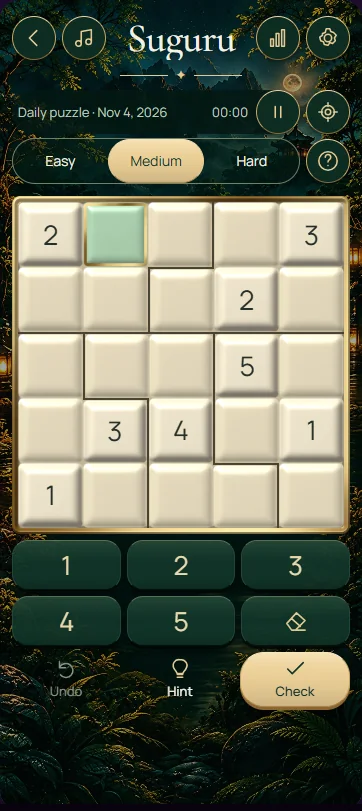
Suguru combines region completion with a strict neighbour rule: fill each region with its required digits, and never let equal digits touch, even diagonally. This 5 × 5 board contains five-cell regions, so each region needs 1–5 exactly once. Rows and columns do not have a separate all-different rule.
Play Suguru online free
Play Suguru online free in your browser. Fill each region of n cells with 1 through n exactly once. Equal digits cannot touch by an edge or a corner, even in different regions.
Follow region boundaries and neighbouring cells
In general Suguru, a region containing n cells takes the digits 1 through n once each. Every region on this board has five cells, making the range 1–5 throughout. Thick boundaries show which cells belong together. A region can bend or span more than one row, so trace its shape before listing the digits it lacks.
Equal digits may not occupy any two cells that share an edge or corner. This restriction applies within a region and across its boundary. Check up to eight surrounding cells when considering a digit. Conversely, matching digits can appear farther apart in the same row or column if they belong to different regions and do not touch.
Enter a value after making both checks
Select an editable cell, then choose a digit on the keypad. Use the erase control to clear a tentative entry. Compare the candidate with the digits already present in its region and with all neighbouring cells before confirming it. Avoid carrying over Sudoku habits: a distant matching digit in another region is not automatically a reason to reject the candidate.
Check solution provides feedback on the current entries. Hint reveals a move from the stored solution, while Start over restores the current board's initial state. If a hint helps you escape a blockage, revisit the cell and identify the region or neighbour restrictions that explain its value. The useful lesson is the deduction you can repeat later.
Work through a region with two empty cells
Suppose a five-cell region already contains 1, 3 and 5. Its two empty cells, A and B, must contain 2 and 4 in some order. Now suppose A touches a confirmed 2 belonging to a neighbouring region. The touching rule removes 2 from A, even if the contact is only diagonal.
A must therefore be 4, leaving 2 for B. Check that A does not touch another 4 and that B does not touch another 2 before entering the pair. This local example assumes the earlier entries are correct. If either check contradicts the deduction, review those entries or your reading of the region boundary rather than forcing the pair into place.
Find the only place for a missing digit
A region can force a placement even when no individual cell initially looks certain. Choose a missing digit, then inspect every empty cell in that region. Existing copies in neighbouring cells may eliminate all positions except one. The surviving position must take the digit because the region is required to contain it.
Keep neighbouring possibilities in view after each placement. Adding a 5 excludes 5 from all touching cells, and it also completes the 5 requirement for its own region. Those two effects can travel in different directions. A distant cell within the same irregular region loses 5 even when it does not touch the new entry.
- Trace the complete region before deciding which digits are missing.
- Check diagonal neighbours as carefully as cells sharing a side.
- Start with nearly complete regions, where only one or two digits remain.
- After a placement, update both the region's missing digits and the candidates of touching cells.
- Search for a digit with only one legal position in a region when cell-by-cell scanning stalls.
Separate useful uncertainty from guessing
Two empty cells that both allow 2 and 4 are an unresolved pair, not an instruction to choose an order. Look at the cells touching either member of the pair, or move to another region. A newly established neighbour can settle the order later. Working between regions is part of the puzzle's logic, not a sign that your first region was the wrong place to start.
Frequently asked questions
Can the same digit repeat in a row or column?
Yes, provided the matching digits belong to different regions and do not touch horizontally, vertically or diagonally. Suguru does not impose Sudoku's row and column uniqueness rule. Each region has its own required set of digits, and the no-touch restriction governs the relationships between nearby cells across the board.
Do all Suguru regions always use the digits 1–5?
Not in every puzzle. A region normally uses the digits from 1 up to its number of cells, each once. On this particular board all regions have five cells, so each uses 1–5. In a different puzzle, a three-cell region would instead contain exactly 1, 2 and 3.
Why does a diagonal neighbour eliminate a candidate?
Suguru forbids equal digits in any two cells touching at an edge or a corner. A diagonal neighbour therefore matters just as much as a horizontal or vertical one. Before placing a digit, inspect all surrounding cells as well as the rest of its region, including cells farther away.
What should I check in a completed Suguru?
Check the required digits in every region and all eight neighbours of every cell. Equal digits must not touch diagonally or by an edge.