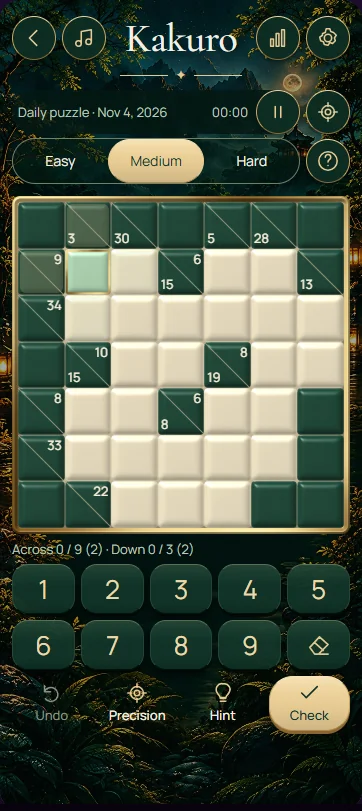
Fill Kakuro's white cells with digits 1–9 so each uninterrupted horizontal and vertical run adds up to its clue, with no repeated digit inside that run. Every white cell participates in crossing sums. A correct entry must satisfy both its across and down possibilities.
Read the clues and use the white cells
In a dark clue cell, the number at the upper right gives the total of the white cells immediately to its right. The number at the lower left gives the total of the white cells immediately below it. A run stops at the next dark cell or the board edge; the clue does not apply to the entire row or column.
Select a white cell and enter a digit with the number buttons or keyboard. Notes lets you record candidates. Use the clear button or Backspace/Delete to erase an editable entry. The dark clue cells are reference information, while any printed numbers inside white cells remain fixed.
Combine sums with the no-repeat rule
Two cells totalling 3 must contain 1 and 2. Two totalling 4 must contain 1 and 3, because 2 plus 2 repeats a digit. Two totalling 17 must contain 8 and 9. Knowing a combination does not yet tell you its order: the crossing runs decide which cell receives which member.
For a worked example, imagine one cell lies in a two-cell across run totalling 3 and a two-cell down run totalling 4. The across run allows 1 or 2 in that cell; the down run allows 1 or 3. Their only shared candidate is 1. The other across cell becomes 2, and the other down cell becomes 3.
Four ways to narrow a difficult run
When a run already contains confirmed digits, subtract them from its target to calculate the remaining total. Keep the no-repeat restriction in the calculation: a digit used earlier in that same run cannot be reused. Digits may repeat in a separate run when its own crossing constraints permit them.
- Start with short runs and extreme totals, such as 3 or 17 across two cells.
- Write possible combinations first, then use crossing clues to establish their order.
- After filling a cell, recalculate the remaining sum in both runs that pass through it.
- Reject a combination that reaches the total but repeats a digit or contradicts a crossing run.
Frequently asked questions
Can the same digit appear twice in a Kakuro row?
It can appear in different runs separated by dark cells, provided each run remains valid. The no-repeat rule applies to an uninterrupted run, not automatically to an entire board row or column. Always check the two crossing runs of the cell where you want to place the digit.
Why is 2 plus 2 invalid for a two-cell clue of 4?
The total is correct, but the repeated digit breaks Kakuro's rule that every digit within a run must be different. With digits 1–9, a two-cell run totalling 4 therefore uses 1 and 3. You still need the crossing clues to determine their order in the two cells.
Should I memorise every Kakuro combination?
No. Recognising a few restrictive totals is helpful, but you can derive combinations by listing distinct digits that fit the run length and target. Then remove options that conflict with crossing runs. Understanding why a combination works is more useful than memorising a long table without applying its constraints.