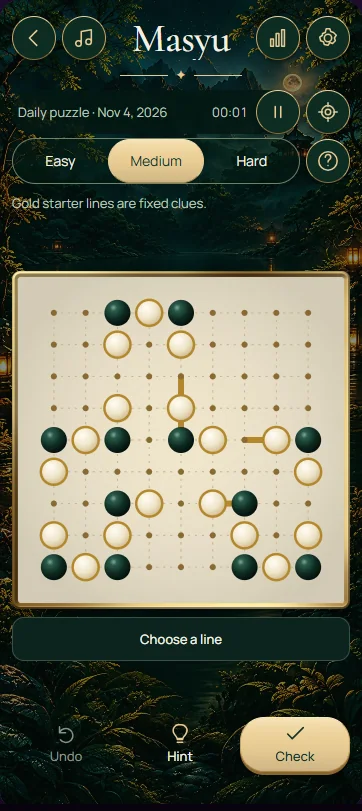
Masyu asks you to draw one closed loop through every black and white pearl. Turn at a black pearl and continue straight through the next position on each side; pass straight through a white pearl and turn at least immediately before or after it. The loop never branches or crosses itself.
Understand what each pearl requires
The board uses horizontal and vertical connections between neighbouring positions. Every visited position has exactly two connected segments: either a straight passage or a right-angled turn. A pearl-free position may remain unused. All pearls must belong to the same loop, so two separate closed loops are not a valid solution even if each visits several clues.
A black pearl is a corner with extra reach. After turning on it, the line must continue straight through the next position in both directions. A white pearl is the opposite local pattern: the line passes straight through the pearl itself, but must turn at one or both of the immediately neighbouring positions along that passage. A turn farther away does not satisfy that requirement.
Draw and revise individual connections
Select a connection between neighbouring positions to turn its line on, then select it again to remove it. This board uses individual segment buttons rather than a continuous freehand drawing gesture. Follow the highlighted lines and inspect both ends whenever you add a connection. An extra segment can accidentally create a branch at a position you already visited.
Hint reveals a move from the stored solution, which may add a needed connection or remove an incorrect one. It does not provide a written deduction. Use the revealed change as something to investigate. Start over clears your progress back to the current puzzle's initial state, while Check solution provides feedback on the current collection of segments.
Work through a black pearl in a corner
Consider a black pearl in the upper-left corner. There is no position above it or to its left, so the required turn must connect rightwards and downwards. The black-pearl rule then extends those two arms: the line continues through the next position to the right and through the next position below, without turning at either of them.
Using row and column coordinates, the corner is r1c1. Its forced connections run through r1c2 to r1c3 and through r2c1 to r3c1. This establishes four segments, not merely the two touching the pearl. The farther endpoints remain open for later deductions. Do not connect them into a small loop until you know every pearl can still be included.
Resolve white pearls and preserve one loop
A white pearl along the top edge cannot have a vertical straight passage, because that would need a connection outside the board. Its passage must therefore be horizontal. At least one neighbouring position on that passage must turn downwards. If another clue forces one neighbour to continue straight, the other neighbour must supply the turn.
Track the endpoints of each growing path. Connecting two endpoints of the same path closes a loop immediately. That is allowed only when the resulting loop already satisfies every pearl and leaves no separate path behind. When a choice seems ambiguous, examine its effect on a nearby pearl's required turn or straight continuation before extending the line.
- Start with corner black pearls and edge white pearls, where the boundary removes directions.
- Extend both arms beyond a black pearl's immediate neighbours before considering the deduction complete.
- For each white pearl, identify which adjacent position provides its required turn.
- Keep every used position at two connections; remove branches rather than working around them.
- Delay closing a loop until all pearls and all drawn segments can belong to it.
Frequently asked questions
Does the loop have to visit every position on the board?
No. The loop must visit every pearl, but pearl-free positions may be used or left unused. Wherever the loop does pass, it has exactly two connections and cannot branch or cross itself. The finished drawing must be one closed loop, with every black and white pearl obeying its own rule.
Must the loop turn on both sides of a white pearl?
It may turn on both sides, but only one immediately neighbouring turn is required. The passage through the white pearl itself must remain straight. Check the positions directly before and after the pearl along the loop; a turn several positions away cannot satisfy this particular white-pearl condition.
Why can I not turn immediately beside a black pearl?
The black pearl already requires a turn at its own position. Its additional rule makes the line continue straight through the neighbouring position on each arm, reaching the following position before another turn is possible. Without those straight extensions, the drawing would satisfy only part of the pearl's requirement.