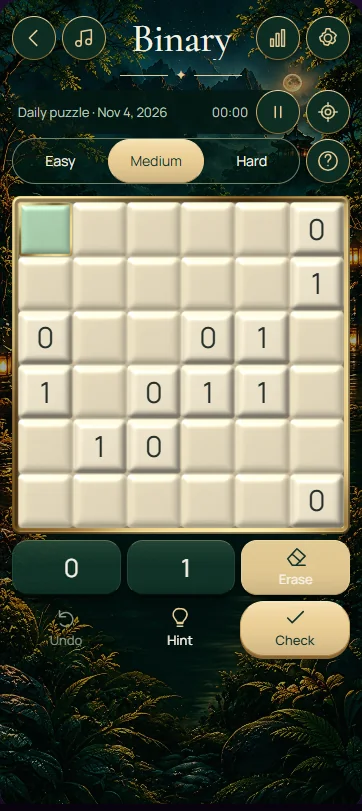
Fill the 6×6 Binary grid with 0s and 1s so every row and column contains three of each, no three equal digits appear consecutively, and no two rows or two columns are identical. Use short patterns and counting deductions, then cross-check the perpendicular line before confirming an entry.
Apply all three rules
Balance means exactly three zeros and three ones in each six-cell row and column. Once a line already contains three zeros, every remaining cell in that line must be 1. Apply the same reasoning when its three ones are already present.
The no-triples rule applies horizontally and vertically. A pair such as 0,0 needs a 1 immediately before or after it wherever those cells exist. A pattern 1, blank, 1 requires 0 in the middle. Diagonal triples are not restricted by this rule.
Rows must differ from other rows, and columns must differ from other columns. A row is allowed to match a column. Two incomplete lines that currently look similar are not necessarily duplicates, so compare their possible completions before using uniqueness to make a deduction.
Work through a uniqueness example
Suppose a completed row reads 0 0 1 0 1 1. Another row reads 0 blank blank 0 1 1. Balance requires one 0 and one 1 in its two blanks. Both possible orders avoid three consecutive equal digits.
The order 0 then 1 would reproduce the completed row exactly, so it is forbidden. The second row must therefore become 0 1 0 0 1 1. Check both changed columns afterward: a correct row deduction also needs to remain consistent with the rest of the grid.
Enter digits and correct a move
Select an editable square, then use the on-screen 0 or 1 button to enter its value. The × button erases the selected entry. Printed clues are shown as fixed cells. The Hint button reveals a correct value, while Check solution checks the current board.
Start over returns the board to its initial clues. If you want to preserve your reasoning, first review the line that caused trouble rather than restarting immediately. Count its zeros and ones, scan consecutive groups of three, and compare any completed rows or columns for duplicates.
Keep deductions local before widening the scan
A forced value often triggers another rule in the perpendicular line. Filling a 1 to break a horizontal triple might complete a column's quota of three ones, forcing its remaining cells to zero. Follow that chain of changes before searching elsewhere.
Do not choose a value simply because both seem harmless in the current row. The column may contain the decisive pattern, or uniqueness may matter after another cell is solved. Keep the square undecided until you can identify the count, pattern, or comparison that forces it.
Tips for your next entry
- Scan for adjacent equal pairs and equal digits separated by one blank.
- Count both symbols in nearly complete rows and columns.
- Compare complete lines with similar lines that have only two blanks.
- After every forced digit, immediately check the perpendicular line.
Frequently asked questions
How many zeros and ones belong in each Binary line?
On this 6×6 board, each row and each column contains exactly three zeros and three ones. Count the two symbols separately as you solve. Once a line has reached three of one symbol, all its remaining blanks must use the other, provided the other puzzle rules remain satisfied.
Are diagonal triples or matching row-column pairs forbidden?
No. The triple restriction applies to consecutive cells within a row or column, not diagonals. Uniqueness compares rows with rows and columns with columns. A row may therefore contain the same sequence as a column. Keep those comparisons separate so you do not remove a valid possibility unnecessarily.
Can I decide a blank by looking at only its row?
Sometimes a row already forces the value through balance or a no-triples pattern. You should still check its column afterward, because that entry may trigger another deduction or expose an earlier mistake. If the row permits both values, inspect the column and relevant uniqueness comparisons before committing either one.