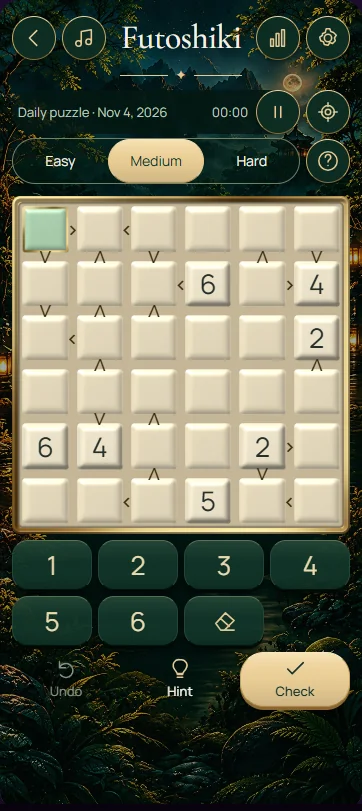
Futoshiki combines a number grid with inequality clues: place 1–5 exactly once in every row and column while making each marked comparison true. Use the comparisons to restrict possible values, then let the row and column rules determine which remaining digit belongs in each cell.
Understand the grid and comparisons
Each five-cell row and column contains 1, 2, 3, 4, and 5 without repeats. There are no Sudoku-style boxes. Printed digits are fixed clues, while empty cells need values that satisfy both their row and their column.
The statement A < B means A is smaller than B; A > B means A is larger. A comparison does not require consecutive values: 1 < 4 is just as valid as 3 < 4. Unmarked neighbours have no additional inequality condition beyond the normal row and column rules.
Treat each marked relationship as a constraint on both cells. In A < B, A cannot be 5 because nothing in the allowed range is larger. B cannot be 1 because nothing is smaller. You can make these exclusions even when neither cell has a confirmed digit.
Use an increasing chain
Suppose three linked cells satisfy A < B < C and A is already 3. Since the largest permitted value is 5, B must be 4 and C must be 5. B cannot be 5 because C would then need a value beyond the allowed range.
Without the confirmed 3, the same chain still provides bounds: A can be at most 3, B must be between 2 and 4, and C must be at least 3. Cross these ranges with digits already used in the relevant rows and columns to narrow the candidates further.
Combine comparisons with missing digits
If a row already contains 1, 3, and 5, its two blanks must be 2 and 4. When an inequality states that the first blank is smaller than the second, their order is forced: 2 then 4. Without that comparison, a crossing column might instead decide the order.
Revisit every inequality touching a newly filled cell. If a cell is now 2, any directly smaller neighbour must be 1. A directly larger neighbour can still be 3, 4, or 5 unless other restrictions remove some of those options. Do not turn a range into an entry prematurely.
Use the number controls
Select an editable square and choose a value from the on-screen 1–5 keypad. Use the × button to erase the selected entry. Hint reveals a correct value, Check solution checks the current board, and Start over restores the initial clues.
Before requesting a hint, examine a nearly complete row or column and the longest comparison chain you can follow. When you do reveal a value, work through its consequences in the crossing lines and adjoining comparisons so the next entry follows from your own deduction.
Tips for following the inequalities
- Remove 5 from the smaller side and 1 from the larger side of every comparison.
- Count the steps in increasing chains to tighten upper and lower bounds.
- Intersect inequality ranges with digits missing from each row and column.
- Check every marked comparison again when one of its endpoints changes.
Frequently asked questions
Do neighbouring Futoshiki numbers have to be consecutive?
No. A marked comparison specifies only which value is smaller or larger. Both 1 < 4 and 3 < 4 satisfy the same direction of comparison. Consecutive values become necessary only when other constraints leave no gap, such as an increasing chain that must fit into the remaining allowed range.
Does Futoshiki use Sudoku boxes?
No. This 5×5 Futoshiki board requires 1–5 once in each row and column, together with its marked inequalities. It does not have separate Sudoku-style boxes. A digit can appear elsewhere outside its row and column, provided every affected comparison remains true and the printed clues are preserved.
How do inequalities help before either value is known?
They restrict the available ranges. In A < B on a 1–5 board, A cannot be 5 and B cannot be 1. A longer increasing chain creates tighter bounds for all its cells. Combine those bounds with digits already used in crossing rows and columns to find forced entries.