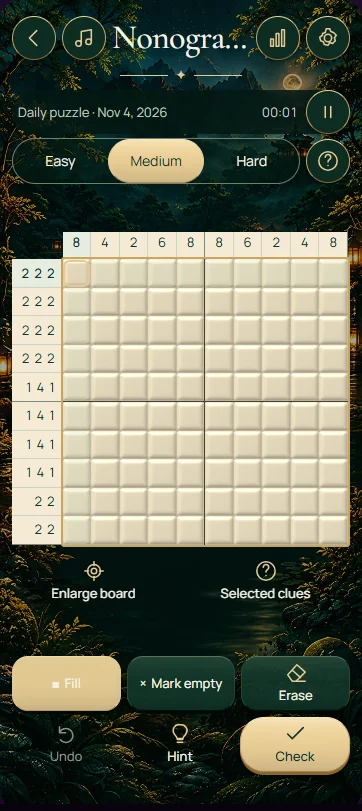
Fill cells in this 8 × 8 Nonogram so the consecutive shaded blocks in every row and column match their clues in the given order. Leave at least one empty cell between neighbouring blocks. Use the clues to determine each mark; the emerging picture is a result of the logic, not a reason to guess.
Read the clues and distinguish empty from unknown
A row clue of 2, 3 means a block of two filled cells followed by a block of three, with at least one empty cell between them. Extra empty cells may appear before, between or after the blocks if space allows. Column clues work the same way from top to bottom. A clue of 0 means the whole line is empty.
Choose Fill, Mark empty or Erase, then select a cell. Right-click marks a cell empty. With keyboard focus on the grid, arrow keys move between cells and Enter or Space applies the chosen mode. An empty mark records a conclusion, while an unmarked cell means you have not decided yet.
Find cells shared by every valid placement
Suppose an eight-cell row has the single clue 5. The block could begin at position 1 and occupy cells 1–5, or begin as far right as position 4 and occupy cells 4–8. Every possible placement fills cells 4 and 5, so you can mark those two cells immediately without knowing the block's final boundaries.
Now compare an eight-cell row with clues 3, 4. The two blocks require seven filled cells plus at least one separating empty cell, using all eight positions. Therefore cells 1–3 are filled, cell 4 is empty and cells 5–8 are filled. Cross-check the columns after each such deduction to uncover further forced marks.
Four ways to connect rows and columns
When a block has reached its required length and its identity is established, the cells immediately beyond its ends must be empty, if those cells exist. Otherwise the block would become too long. Those empty marks can divide another line into smaller spaces and limit where its remaining blocks fit.
- Start with zero clues, fully determined lines and long blocks whose extreme placements overlap.
- Count the mandatory gaps between blocks when calculating how much space a clue sequence needs.
- After marking a row cell, inspect its column instead of repeatedly working on the same line.
- Check clue order and completed block boundaries before relying on the outline of the emerging picture.
Frequently asked questions
What does a clue such as 2, 3 mean?
It specifies two separate filled blocks in that order: first two consecutive cells, then three consecutive cells. At least one empty cell must separate the blocks. Additional empty cells can appear wherever the line's remaining space permits, but the blocks cannot be reversed or joined into a single group.
Why should I mark empty cells instead of leaving them blank?
An empty mark distinguishes a cell you have logically excluded from a cell that is still unknown. That distinction helps you see available spaces and stops you from reconsidering settled positions. Empty cells also separate completed blocks, so their locations can provide useful constraints for the crossing rows and columns.
Should I fill cells because the picture looks symmetrical?
No. A promising shape or apparent symmetry is not a clue unless the puzzle explicitly makes it a rule. Use the row and column numbers to justify each mark. Guessing from the picture can create a convincing outline that still violates a block length, its order or a required gap.